




Galvanized vs Stainless Anchor Chain: An Honest Comparison
The 30-second answer
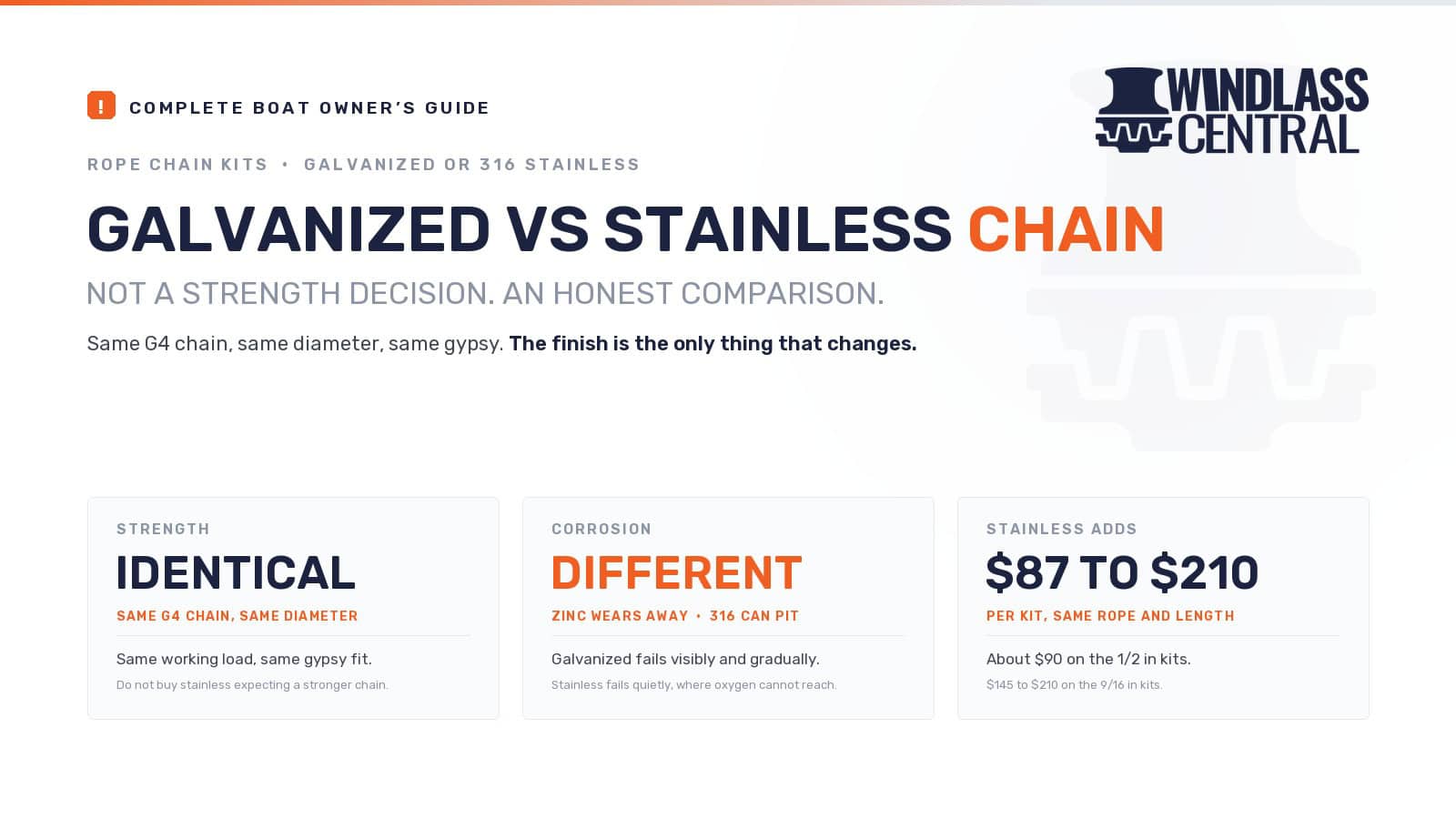
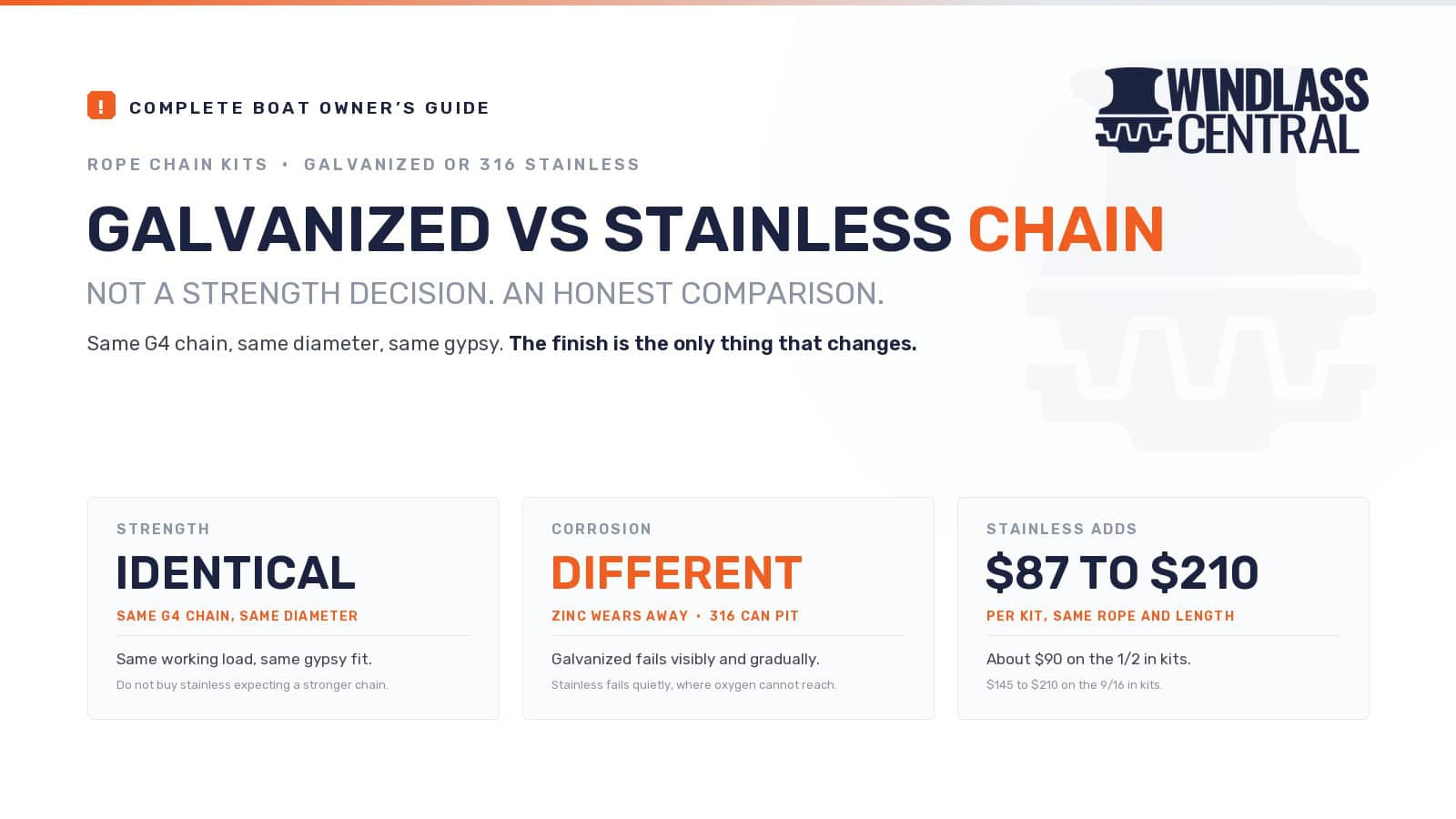
Galvanized vs stainless anchor chain is not a strength decision. Our kits use the same G4 chain in the same diameters, so both hold the same load and run through the same gypsy. What changes is how the chain corrodes, how the bow looks after a season, and roughly $90 to $210 on the price. Galvanized is the value pick for boats that anchor hard. Stainless is for boats where the bow is on show.
Galvanized vs stainless anchor chain is one of the first questions to settle when you buy a rope chain kit, and the honest answer is shorter than most of what is written about it. Neither finish holds better than the other. The chain nearest the anchor does the same job in both, at the same rated load. The real choice is about how the chain ages, what it does to your gelcoat, and whether the price gap is worth it for the way you use the boat.
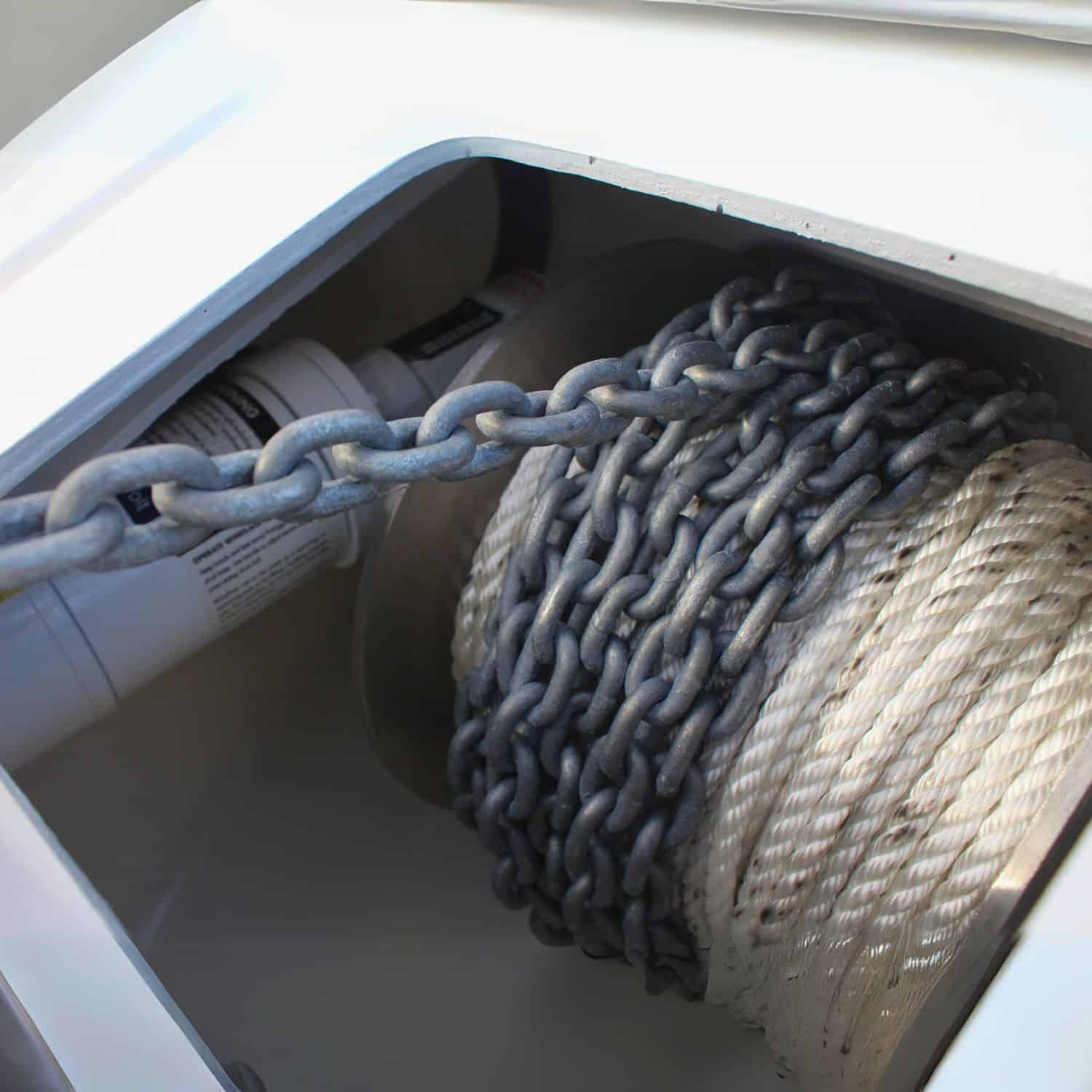
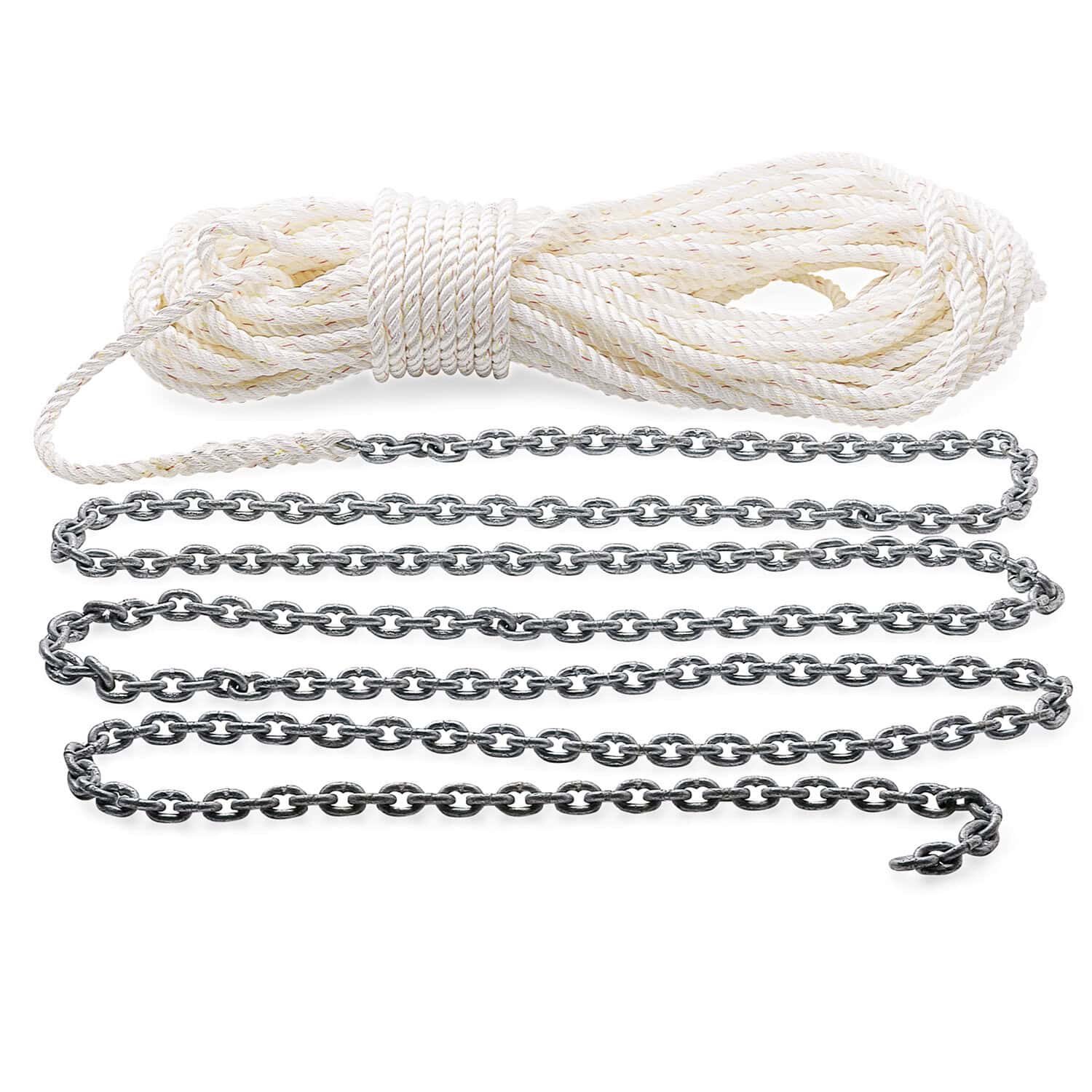
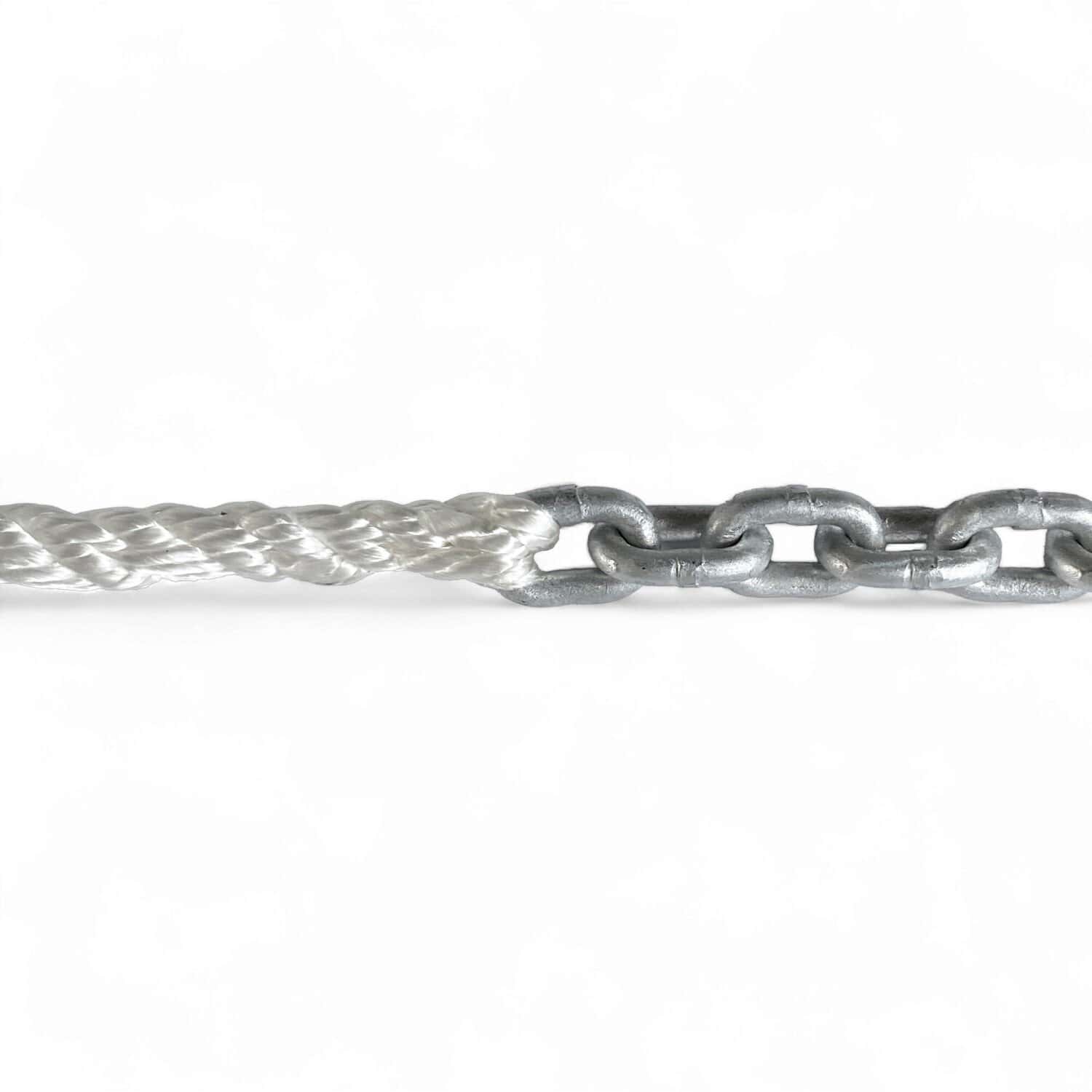
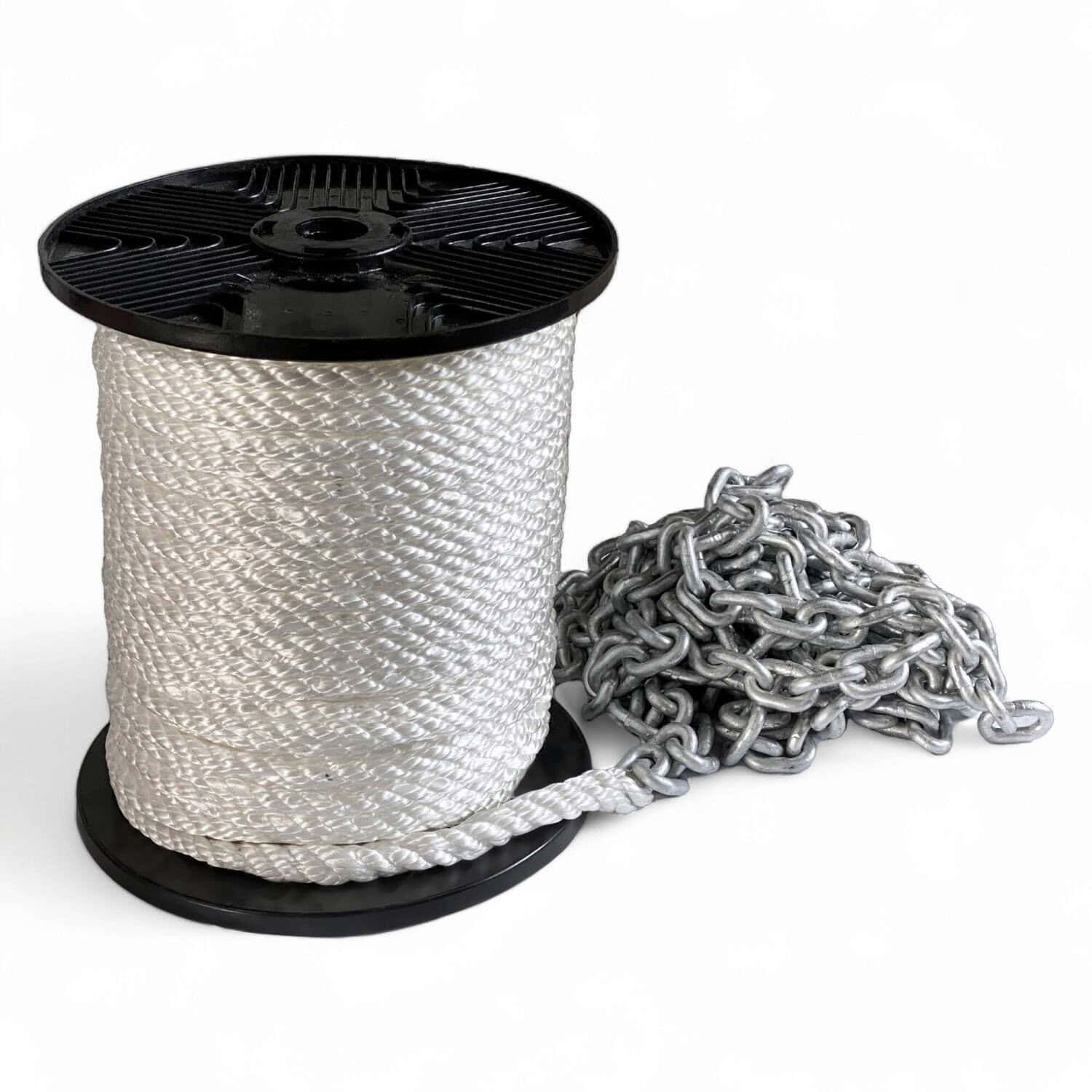
Every kit in this guide is the same kit in two finishes: three-strand nylon rope spliced to G4 chain, with hot-dip galvanized chain in one listing and 316 stainless in the other. That is what makes the galvanized vs stainless anchor chain price comparison further down a clean one. The finish is the only thing that changes.
Galvanized vs stainless anchor chain: what is actually different
Four things separate the two finishes, and only one of them is the strength most people assume:
- Corrosion. What each finish does in salt water, and how it fails.
- Strength. The same, size for size, but with a difference in how much warning you get.
- Looks. The reason most people pay the difference.
- Price. About $90 more for stainless on the 1/2 in kits, $145 to $210 more on the 9/16 in kits.
Everything else, from weight to gypsy fit to the splice, is identical, because the chain diameter and pitch are identical.
Corrosion: how galvanized vs stainless anchor chain fails
Hot-dip galvanized chain
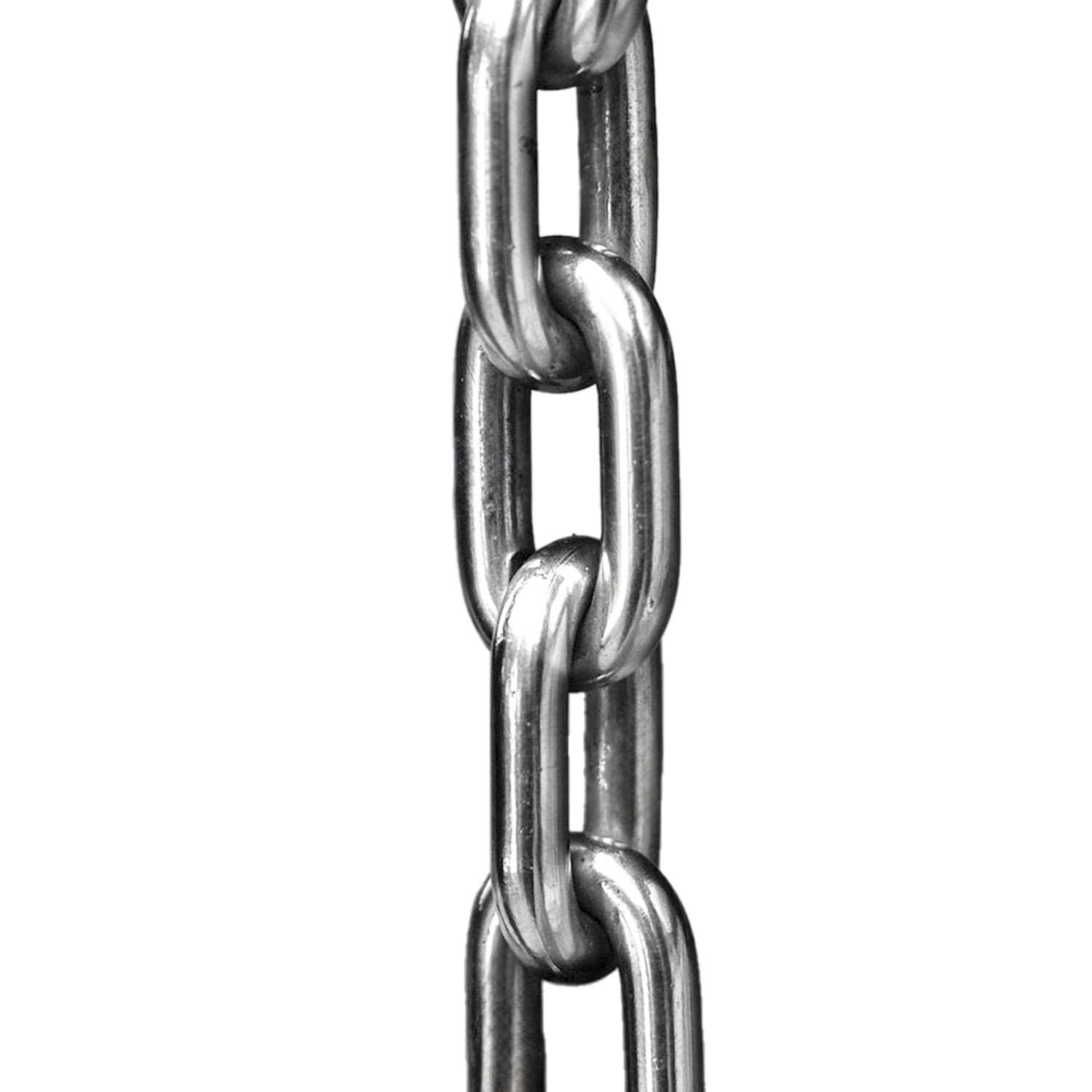
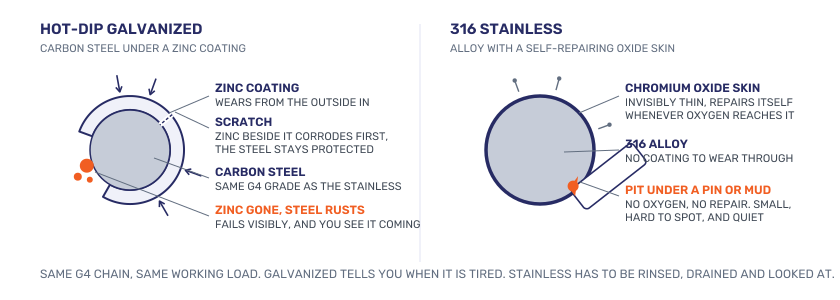
Galvanized chain is carbon steel dipped in molten zinc. The zinc is a barrier between seawater and the steel, and because zinc is more reactive than steel it corrodes first, so even a scratch through the coating is protected by the zinc around it. The American Galvanizers Association calls this barrier and sacrificial protection, and it is why galvanized chain can look scruffy long before it is weak.
The coating is consumed from the outside in. It wears fastest on the links that drag across sand and shell at the anchor end, and where the chain works through the gypsy. Once the zinc is gone from a link the steel rusts, and you will see it. On a boat that anchors most weekends in warm salt water, expect the anchor end to show rust within a few seasons; a boat on a marina berth that anchors occasionally gets considerably longer. When the zinc is gone you replace the chain, or regalvanize a longer one, for a fraction of the stainless price.
316 stainless steel chain
Stainless does not rely on a coating. The chromium in the alloy forms an invisible oxide layer that repairs itself whenever it is exposed to oxygen, which is why 316 stays bright in open seawater year after year. It does not stain the deck, it does not streak the bow, and it never needs regalvanizing.
The honest caveat is that stainless needs oxygen to stay that way. Packed wet into a closed locker with mud between the links, or sitting under a shackle pin, the oxide layer cannot repair itself and 316 can pit and crevice-corrode. It rarely fails from this, but the damage is small and hard to spot, so a stainless rode wants a freshwater rinse after a muddy anchorage, a locker that drains, and a look at the last few links each season. Pair it with stainless shackles and swivels: a galvanized shackle on a stainless chain loses its zinc quickly, because it is now protecting the chain as well as itself.
Strength: same size, same working load
This is where most comparisons go vague, so we will be specific. Our kits pair the same chain diameter in both finishes, 1/4 in on the 1/2 in rope kits and 5/16 in on the 9/16 in rope kits, and both are supplied as G4 (high-test) grade. Size for size, the rated working load is the same. Do not buy the stainless kit expecting a stronger chain, and do not avoid it expecting a weaker one.
The real strength difference in the galvanized vs stainless anchor chain question is the warning you get. Galvanized chain tells you when it is tired: the finish goes dull, then patchy, then brown. Stainless can look perfect right up until it is not, which is why the inspection habit above matters more than the grade stamp.
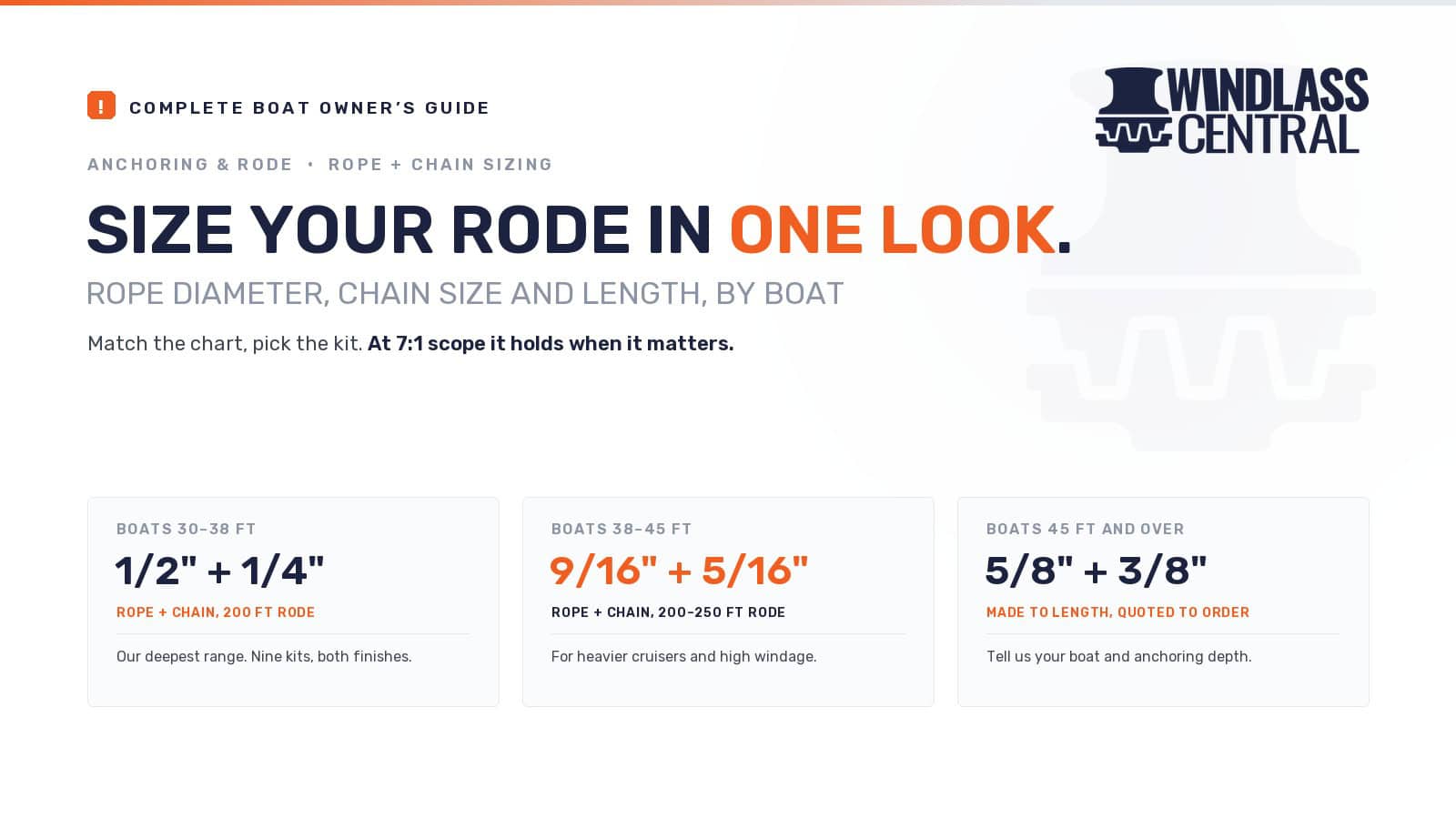
Neither finish changes gypsy fit. The gypsy on your windlass is cut for one chain diameter and one pitch, and both versions of each kit use the same chain, so if the galvanized kit fits, the stainless kit fits. If you are still working out the size, our anchor rope and chain sizing guide matches rope, chain and rode length to boat length.
Looks: the reason most people pay the difference
Looks are where galvanized vs stainless anchor chain part company fastest. Galvanized chain starts a dull grey and stays that way until the zinc wears, when it goes mottled and then rusty. Every time it comes over the bow roller wet it leaves a little of that behind, and on a white gelcoat bow the brown streaks show. It is cosmetic, and an oxalic acid cleaner takes it off, but you will be the one taking it off.
Stainless chain looks the same in year five as it did in the box. If the rest of the foredeck is stainless, the bow roller, the cleats and a 316 stainless anchor, a galvanized chain is the one thing that looks out of place, and a stainless one completes the set. On boats that are looked at as much as they are used, that alone is worth the money to most people who buy it.
Price: what stainless adds on our kits
Because each kit is the same rope, length and chain size in two finishes, the galvanized vs stainless anchor chain price gap is easy to read. On the 1/2 in kits, stainless adds about $90. On the 9/16 in kits, which carry more chain in a bigger link, it adds between $145 and $210. Prices below are as listed at the time of writing; the product page always shows the current figure.
| Kit | Galvanized | 316 stainless | Stainless adds |
|---|---|---|---|
| 1/2 in × 100 ft rope, 1/4 in × 15 ft chain | $166.09 | $252.79 | $86.70 |
| 1/2 in × 150 ft rope, 1/4 in × 15 ft chain | $191.93 | $285.34 | $93.41 |
| 1/2 in × 200 ft rope, 1/4 in × 15 ft chain | $221.17 | $309.00 | $87.83 |
| 9/16 in × 150 ft rope, 5/16 in × 20 ft chain | $250.58 | $415.73 | $165.15 |
| 9/16 in × 200 ft rope, 5/16 in × 20 ft chain | $275.57 | $485.86 | $210.29 |
| 9/16 in × 250 ft rope, 5/16 in × 20 ft chain | $324.02 | $502.94 | $178.92 |
| 9/16 in × 300 ft rope, 5/16 in × 20 ft chain | $373.15 | $519.26 | $146.11 |
Swipe to see all columns →
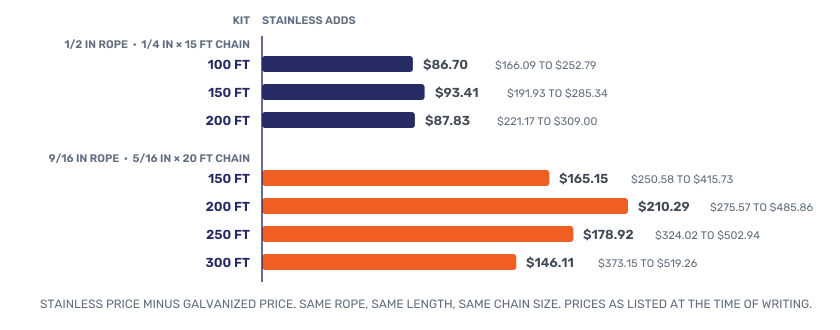
Put that against the life of the rode. A nylon rode lasts five to seven years on a boat that anchors regularly, so the 1/2 in gap works out at around $15 a year. A boat that anchors hard will probably replace or regalvanize a galvanized chain once in that time, which closes much of the gap. A boat that anchors a few times a season will not, and for that boat the galvanized kit is real money saved. That is the whole galvanized vs stainless anchor chain trade-off, and it depends on you rather than on the chain.
Which kit that means for you
Here is the galvanized vs stainless anchor chain decision in practice.
Choose the galvanized kit if
- The boat anchors hard: most weekends, mud and shell bottoms, or it works for a living. You will wear out any chain, and galvanized is the cheaper one to wear out.
- The bow is not on show, or you do not mind cleaning it a couple of times a season.
- You would rather have a chain that shows its age than one you have to inspect for it.
- You would rather spend the difference on rode. The 200 ft galvanized kit costs less than the 100 ft stainless kit, and 200 ft covers most mid-size cruisers at 7:1 scope.
Choose the stainless kit if
- White gelcoat, a stainless bow roller and stainless fittings, and you are tired of rust streaks down the bow.
- The boat gets a freshwater rinse after use and the locker drains. Stainless rewards that kind of ownership.
- You anchor occasionally in clean sand, and the chain spends most of its life in the locker looking good.
- You want to fit the rode once and never think about regalvanizing.
Whichever way you lean, buy the size your windlass and boat need first and choose the finish second. These are the kits we stock in both finishes, with the galvanized and 316 stainless version of each linked side by side:
- 1/2 in × 100 ft rope with 1/4 in × 15 ft chain: galvanized kit · 316 stainless kit
- 1/2 in × 150 ft rope with 1/4 in × 15 ft chain: galvanized kit · 316 stainless kit
- 1/2 in × 200 ft rope with 1/4 in × 15 ft chain: galvanized kit · 316 stainless kit
- 9/16 in × 150 ft rope with 5/16 in × 20 ft chain: galvanized kit · 316 stainless kit
- 9/16 in × 200 ft rope with 5/16 in × 20 ft chain: galvanized kit · 316 stainless kit
- 9/16 in × 250 ft rope with 5/16 in × 20 ft chain: galvanized kit · 316 stainless kit
- 9/16 in × 300 ft rope with 5/16 in × 20 ft chain: galvanized kit · 316 stainless kit
Two stainless-only options are worth knowing about. Above 200 ft in 1/2 in rope we stock stainless only, in 250 ft and 300 ft. And if you want the stainless finish for shallow-water anchoring without paying for chain you will not use, the 100 ft kit with a shorter 10 ft stainless chain is priced below the 15 ft galvanized equivalent. For rough ground in the 9/16 in size, there is also a 250 ft kit with 25 ft of stainless chain.
Frequently asked questions
Galvanized vs stainless anchor chain: which lasts longer?
Stainless, provided it is rinsed and stored where it can dry. In open seawater 316 does not wear the way a zinc coating does, so the chain will usually outlast the rope it is spliced to. Galvanized chain lasts as long as its zinc, which on a boat that anchors often means the anchor end shows rust within a few seasons. At that point you replace it, or regalvanize a longer chain, for far less than the stainless kit cost.
Is stainless anchor chain stronger than galvanized?
Not in our kits. Strength is a tie in the galvanized vs stainless anchor chain comparison: both are G4 chain of the same diameter, so the rated working load is the same. Strength comes from the grade and the link size, not the finish. Where they differ is warning. Galvanized chain rusts visibly as it ages, while stainless can look perfect until you inspect the last few links.
Can I run a stainless chain on a galvanized anchor?
Yes, and plenty of boats do. Connected in seawater, the zinc on the anchor around the shackle wears a little faster because it is now protecting the stainless chain as well as the anchor. The parts that matter are the small ones: use a stainless shackle and swivel so they are not the sacrificial link in the chain.
Does stainless anchor chain need a different gypsy?
No. Each of our kits uses the same chain diameter and pitch in both finishes, so whichever version fits your windlass, the other does too. The gypsy on your windlass is cut for one chain size, so check the spec sheet before ordering either kit.
Why is the stainless premium bigger on the 9/16 in kits?
More chain, in a bigger link. The 9/16 in kits carry 20 ft of 5/16 in chain against 15 ft of 1/4 in on the 1/2 in kits, which is roughly twice the weight of chain, so the stainless premium is paid on twice as much metal.
Still weighing galvanized vs stainless anchor chain?
Send us your boat length, where you usually anchor and whether the bow gets rinsed after a trip. We will tell you which rode to run, and which version of the kit to buy.
Related guides
Stay Updated
Get the latest guides, tips, and product updates delivered to your inbox.